
LED tail lights are rapidly replacing halogen as the standard for modern vehicles. But is upgrading worth the investment? TUHO Lighting manufactures high-quality LED tail light systems for automotive applications.
The Tail Light Evolution
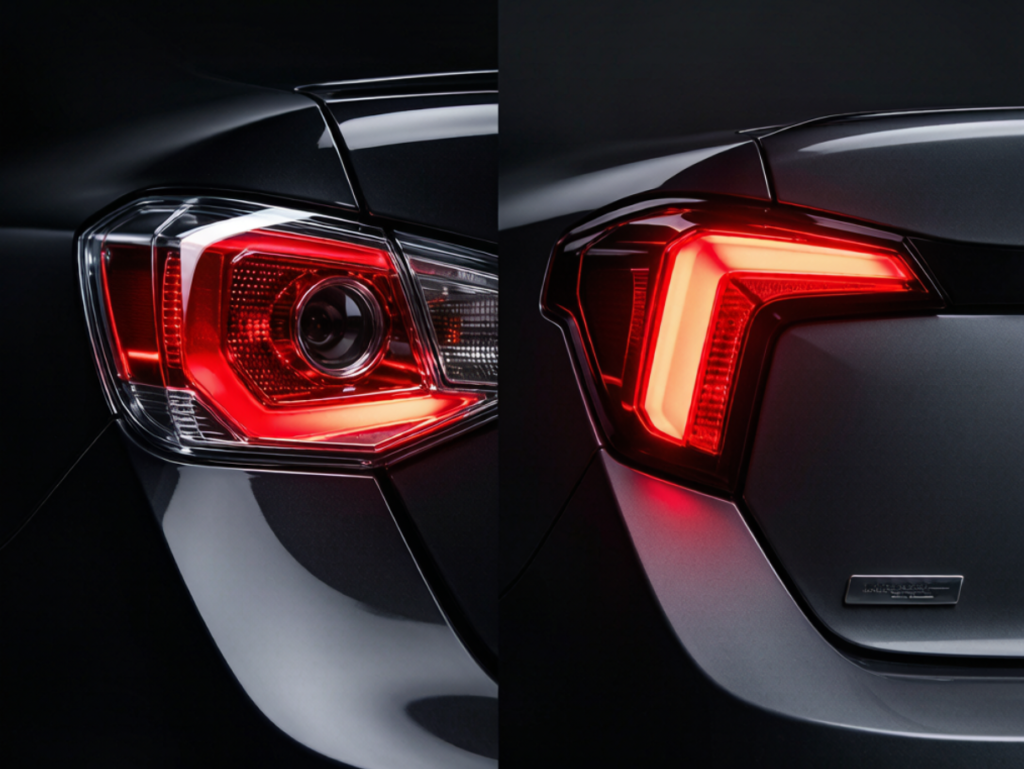
For decades, halogen bulbs were the standard for tail lights. Today, LED technology dominates new vehicle designs and is a popular upgrade for older cars. The differences go beyond appearance — LEDs offer significant performance and safety advantages. The Wikipedia article on LED lamps explains the technology behind modern automotive lighting.
Halogen Tail Lights Explained
Halogen tail lights use a filament that glows when electricity passes through it. They produce warm orange-red light. Halogen bulbs are inexpensive to replace but have several drawbacks: they dim over time, have slow response times, and consume more power. A typical halogen tail light bulb lasts 1,000-2,000 hours. They are being phased out in favor of LED in new vehicle designs.
LED Tail Lights Explained
LED tail lights use light-emitting diodes that convert electricity directly into light: They illuminate instantly (no warm-up time). They maintain consistent brightness throughout their lifespan. LEDs are significantly more durable, vibration-resistant, and energy-efficient than halogen bulbs. A quality LED tail light can last 30,000-50,000 hours — potentially the entire life of the vehicle. TUHO LED tail light products use premium LED chips for maximum reliability.
Brightness Comparison
| Aspect | Halogen | LED |
|---|---|---|
| Typical brightness | 50-100 lm | 200-500 lm |
| Light quality | Warm, yellowish | Pure red, consistent |
| Dimming over time | Yes, gradually | No, consistent |
| Visibility distance | Standard | Up to 2x further |
Response Time
LED tail lights illuminate approximately 200 milliseconds (0.2 seconds) faster than halogen bulbs. At highway speeds (65 mph), this translates to nearly 20 feet of additional stopping distance for the driver behind you. This faster response time can be the difference between a rear-end collision and a safe stop. The SAE automotive lighting standards recognize the safety advantages of LED response times.
Lifespan Comparison
Halogen tail light bulbs: 1,000-2,000 hours (approximately 1-3 years of normal driving). LED tail lights: 30,000-50,000 hours (potentially the entire vehicle life). Over a 10-year vehicle ownership period, halogen bulbs may need replacement 3-10 times, while LEDs will likely never need replacement. This makes LEDs more economical long-term despite higher initial cost.
Energy Efficiency
LED tail lights consume 80-90% less power than equivalent halogen bulbs. A typical halogen tail light draws 21 watts. An LED equivalent draws 2-5 watts for comparable or better brightness. This reduced electrical load is beneficial for the vehicle’s electrical system, especially in modern cars with numerous electronic systems. Reduced power consumption also means less strain on the alternator.
Cost Analysis
Halogen bulbs: $3-10 per bulb. LED tail lights: $20-80 per bulb (premium). Over 10 years of ownership: halogen costs $30-100 in replacements. LED costs $20-80 once (no replacements needed). When factoring in installation labor, LED is often the more economical choice over the vehicle’s lifetime.
Safety Benefits
LED tail lights offer three key safety advantages: faster illumination (earlier warning to following drivers), brighter light (better visibility in adverse conditions), and consistent brightness (no dimming over time). These factors contribute to reduced rear-end collision risk. Many insurance providers offer discounts for vehicles equipped with LED lighting.
Comparison Table
| Feature | Halogen | LED |
|---|---|---|
| Brightness | 50-100 lm | 200-500 lm |
| Response time | ~250 ms | ~50 ms (instant) |
| Lifespan | 1,000-2,000 hrs | 30,000-50,000 hrs |
| Power draw | 21W per bulb | 2-5W per bulb |
| Heat output | High | Low |
| 10-year cost | $30-100 | $20-80 |
FAQ
Are LED tail lights worth the upgrade?
Yes. LEDs offer better brightness, faster response, longer life, and lower energy consumption. The initial cost is offset by never needing replacement.
Can I replace halogen tail lights with LED?
Yes, if you choose compatible LED bulbs. Some vehicles may require load resistors or Canbus decoders to prevent hyper-flashing.
Do LED tail lights require resistors?
Some vehicles need load resistors to simulate the halogen bulb’s electrical load and prevent error messages or hyper-flashing.
How long do LED tail lights last?
30,000-50,000 hours — potentially the entire life of the vehicle under normal use.
LED Tail Lights from TUHO Lighting
Upgrade your tail lights to LED with TUHO. Brighter, faster, longer-lasting, and more efficient. Shop our LED tail light range or contact us for OEM/ODM wholesale inquiries.