 跳至内容

Short answer: Yes, 194 and 168 bulbs are interchangeable in most sockets. Both are T10 wedge bulbs with the same base and nearly the same size. The 168 is generally the brighter, higher-wattage version, so use the bulb your owner’s manual specifies where brightness or heat matters, such as instrument lighting.
Key takeaways
- 194 and 168 share the T10 wedge base, so they physically swap.
- The 168 is the brighter bulb and the 194 is the lower-output one.
- Some manuals specify one number for instrument or switch lighting, so follow the manual there.
- With LEDs, the 194 vs 168 split matters less. Check base, voltage, polarity and Canbus instead.
Are 194 and 168 bulbs the same?
194 and 168 bulbs are not identical, but they are close enough to swap in most sockets. Both use the same T10 wedge base, so either one plugs in.
The difference is output:
- Base and size: the same T10 wedge base and similar glass size.
- Brightness: the 168 is generally rated brighter than the 194.
- Power and heat: the brighter 168 draws a little more power and runs warmer.
The 194 is also sold as W5W in many markets. Check your socket and your manual if you are unsure.
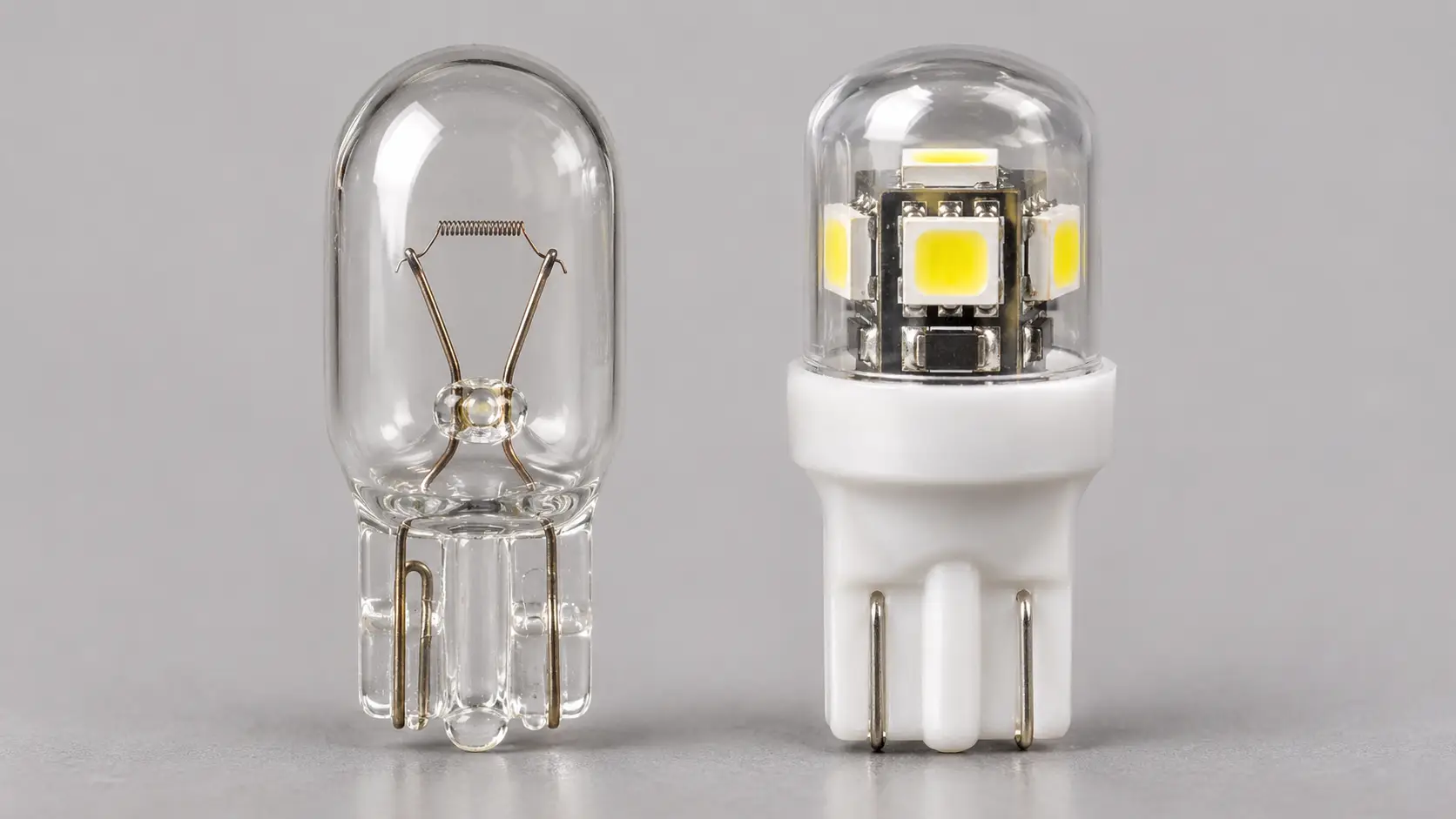
What is the difference between 194 and 168 bulbs?
The main difference is brightness and power, not fit. This table compares the two.
| Feature | 194 | 168 |
|---|---|---|
| Base type | T10 wedge | T10 wedge |
| Fit in the same socket | Yes | Yes |
| Brightness | Lower output | Brighter |
| Power and heat | Lower | Higher |
| Typical use | Instrument, courtesy and license plate lighting | Positions that need more light, such as map and dome lights |
| Other names | T10, W5W | T10 |
Typical uses are a general guide. Vehicle makers specify the bulb for each position, so the manual is the final word.
When does it matter which one you use?
It matters most in instrument lighting and any spot where a brighter bulb could be too bright or run too warm. In courtesy and license plate positions, either bulb usually works.
- Instrument cluster and switches: follow the manual. A brighter bulb can look too bright at night.
- Map and dome lights: the 168 gives more light if the housing allows it.
- License plate and parking lights: either bulb usually fits, and many owners now fit LEDs. Our guide on replacing a license plate light shows the steps.
Are 194 and 168 the same for LED bulbs?
For LED bulbs, 194 and 168 are usually the same fit, because LED versions are built for the T10 base. The old halogen difference in brightness no longer decides the choice.
These points matter more with LEDs:
- Base: confirm T10 wedge. Some models also come in BA9S, T5 or B8.x bases.
- Voltage: most listings are 12V, and some are 10-30V.
- Polarity: non-polar bulbs work in either orientation. Polar bulbs may need to be flipped if they do not light.
- Canbus: choose a Canbus version if the car shows a bulb-out warning with LEDs.
- Brightness: LED output is listed in lumens, so compare lumens, not the 194 or 168 label.
What should distributors stock?
Distributors should list T10 LED bulbs under 194, 168, T10 and W5W, because buyers search by all four numbers. A clear cross-reference cuts wrong-bulb returns.
- Cross-reference labels: put 194, 168, T10 and W5W on the listing and the box.
- Polarity: offer non-polar versions to reduce “it does not light” complaints.
- Canbus option: stock a Canbus version for cars that flag bulb-out errors.
- Lumen grades: offer a lower-lumen option for instrument lighting and a brighter one for interior lights.
- Return reasons: wrong base, wrong polarity and bulb-out warnings are common causes, so include fit notes in your listing.
How TUHO supplies this category
TUHO is an LED automotive lighting manufacturer in Dongguan, China, and its T10 / W5W / 194 LED bulbs are grouped by chip type.
- CREE LED T10 / W5W / 194 Bulbs: a family of 6 models, with 12V and 12-18V versions, Canbus and non-polar options, and lumens listed from 62 lm to 140 lm in the factory catalog.
- 3014 SMD LED T10 / W5W / 194 Bulbs: a family listing 12V, 12-18V and 10-30V models, with Canbus and non-polar versions.
- COB LED T10 / W5W / 194 Bulbs and 5050 SMD LED T10 / W5W / 194 Bulbs cover other chip choices.
Lumen and power figures are as listed in the factory catalog, not independent test results. Product pages list custom logo, color box and outer carton support. Delivery is usually arranged within 1-10 working days, depending on quantity, and required documents are confirmed per model and per order. TUHO’s quality control process includes burn-in and waterproof testing.
Sourcing T10 LED bulbs for your range? TUHO supports OEM/ODM projects, custom logo and packaging, mixed-SKU orders and sample testing. See the OEM/ODM page or request a quote.
FAQ
Can I use a 194 bulb instead of a 168?
Yes, you can use a 194 bulb instead of a 168 in most sockets because both share the T10 wedge base. The 194 is a little dimmer, so check your manual for instrument lighting.
Is a 168 brighter than a 194?
Yes, a 168 is generally brighter than a 194 and draws a bit more power. The difference is small, and it matters mainly with halogen bulbs.
Is a 194 the same as a W5W or T10 bulb?
A 194 bulb is the same T10 wedge size that many markets call W5W, and T10 describes the bulb shape and base. Check the base and voltage on the package before you buy.
Do I need Canbus for 194 or 168 LED bulbs?
You only need Canbus 194 or 168 LED bulbs if your car shows a bulb-out warning with LEDs fitted. Many cars work with standard bulbs, so test one before ordering in bulk.
Bottom line: 194 and 168 are interchangeable in most T10 sockets, with the 168 being the brighter one. For LEDs, compare base, voltage, polarity, Canbus and lumens instead.
Editorial note: Written in November 2026 from general bulb-cross-reference practice and a competitor guide read for structure only. No external standard or datasheet could be opened and verified, so bulb brightness is described qualitatively. TUHO figures are as listed on the product pages and the factory catalog.
