

Canbus compatibility is one of the most confusing aspects of upgrading to LED headlights. Understanding the difference between Canbus and non-Canbus LED bulbs ensures a successful installation without error messages. TUHO Lighting offers both Canbus-ready and standard LED headlight bulbs for all vehicle types.
What Is Canbus?
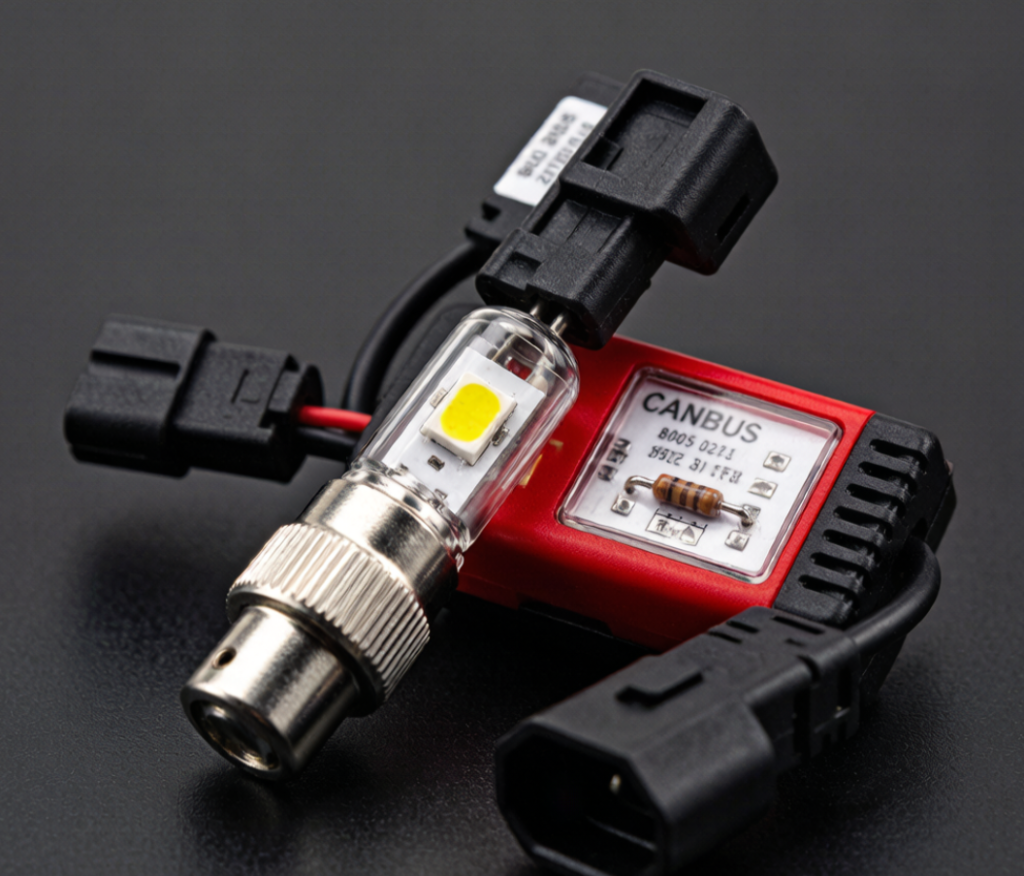
CAN bus (Controller Area Network) is a vehicle communication system that monitors electrical components. Modern vehicles use Canbus to detect bulb failures by measuring electrical resistance. When a bulb burns out, the resistance changes, and the vehicle alerts the driver. The Wikipedia article on CAN bus explains this vehicle communication protocol in detail.
The LED Compatibility Problem
LED bulbs draw significantly less power than halogen bulbs, which creates a compatibility issue with Canbus systems: A halogen headlight bulb draws 55W. An equivalent LED draws 20-35W. The vehicle’s Canbus system detects this lower power draw as a “bulb out” condition, triggering warning messages, fast blinking (hyper-flash), or complete deactivation of the circuit. This is why some vehicles require special Canbus-compatible LED bulbs or additional components.
Canbus LED Bulbs Explained
Canbus LED bulbs have built-in resistors or decoder circuitry that simulates the electrical load of a halogen bulb. This prevents the vehicle from detecting the lower power draw. Canbus bulbs are plug-and-play for most vehicles. They are slightly longer than standard LEDs due to the additional circuitry. Premium Canbus LED bulbs use high-quality resistors that generate less heat. TUHO Canbus LED bulbs are designed for silent, error-free operation.
Non-Canbus LED Bulbs Explained
Non-Canbus LED bulbs do not have built-in load resistors. They are simpler, shorter, and typically less expensive. They work perfectly on vehicles without Canbus monitoring systems. On Canbus-equipped vehicles, they may trigger warning lights or hyper-flash. Non-Canbus bulbs require external load resistors for Canbus vehicle compatibility. They are ideal for older vehicles (pre-2000s) that do not have bulb failure detection systems.
Which Vehicles Need Canbus?
| Vehicle Type | Canbus Required? | Notes |
|---|---|---|
| European (BMW, Audi, Mercedes, VW) | Yes, most models | Strict Canbus monitoring |
| Asian (Toyota, Honda, Hyundai) | Some models (2010+) | Varies by model year |
| American (Ford, Chevrolet, Dodge) | Some models (2012+) | Increasingly Canbus-equipped |
| Older vehicles (pre-2005) | Rarely | No Canbus system |
Symptoms of Canbus Mismatch
Dashboard warning light for bulb failure, fast blinking of turn signals (hyper-flash), LED bulbs that flicker or pulse, headlights that turn off intermittently, or LED bulbs that do not work at all. These symptoms indicate the vehicle’s Canbus system is detecting the lower power draw. Canbus-compatible LED bulbs or external load resistors resolve these issues.
Load Resistors vs Canbus Bulbs
External load resistors are an alternative to Canbus LED bulbs. They are wired in parallel with the LED bulb to simulate halogen load. Pros: cheaper than Canbus bulbs, can be used with any LED bulb. Cons: generate significant heat (can melt wiring if not properly installed), require additional wiring work, larger and harder to hide. Canbus LED bulbs with built-in resistors are generally the cleaner, safer solution.
Cost Comparison
Non-Canbus LED bulbs: $15-40 per pair. Canbus LED bulbs: $30-80 per pair. External load resistors: $10-20 per pair (additional). For Canbus vehicles, Canbus LED bulbs offer better value considering the cleaner installation and included load management. For non-Canbus vehicles, standard non-Canbus LEDs are the most affordable option.
Which Should You Choose?
Check your vehicle’s compatibility first. Research your specific make, model, and year. If your vehicle is Canbus-equipped, choose Canbus LED bulbs for plug-and-play installation. If you are unsure, Canbus bulbs work on both Canbus and non-Canbus vehicles, making them the safe universal choice. For older vehicles without Canbus, standard non-Canbus LEDs are perfectly adequate. TUHO offers both options with compatibility guidance for popular vehicle models.
FAQ
Do I need Canbus LED bulbs for my car?
Check your vehicle manual or research online. European vehicles (BMW, Audi, Mercedes) typically require Canbus. Older vehicles do not.
What happens if I use non-Canbus LEDs on a Canbus vehicle?
You may get dashboard warning lights, hyper-flash (fast blinking), or the LEDs may not work at all.
Can I add resistors to non-Canbus LEDs?
Yes, external load resistors can make non-Canbus LEDs compatible with Canbus systems. Professional installation is recommended.
Are Canbus LED bulbs more expensive?
Yes, typically $30-80 per pair compared to $15-40 for non-Canbus, due to the built-in decoder circuitry.
Canbus-Compatible LEDs from TUHO
TUHO Canbus LED headlights offer error-free installation on all vehicle types. Built-in decoders, premium LED chips, and comprehensive compatibility. Shop Canbus LED bulbs or contact us for vehicle-specific compatibility advice.